
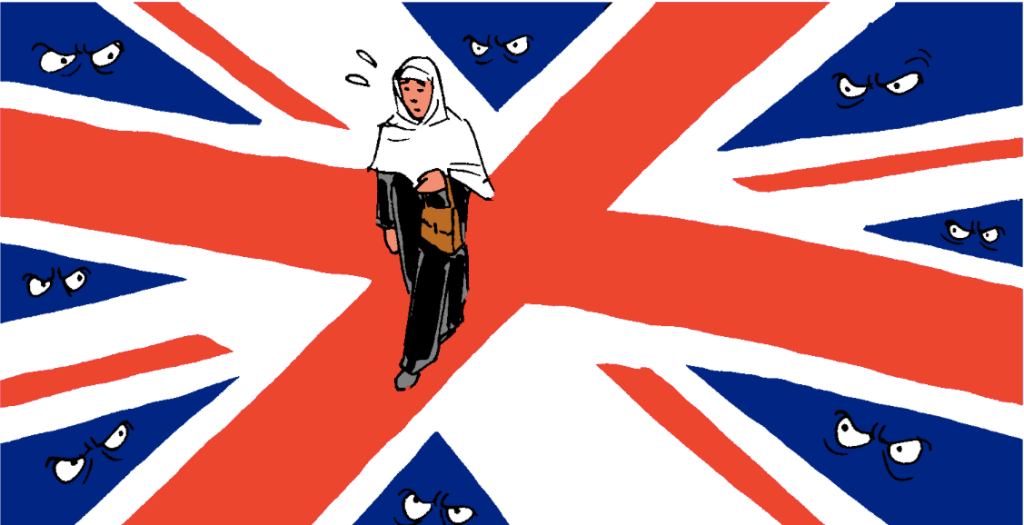
For the last few years, the British press has been carrying out a one-sided, prejudiced and provocative editorial policy towards the Muslim community in the country. It is almost as if there are two separate communities, ‘us’, that is, the community born and raised in this beautiful island country, and ‘Muslims’, who are labelled as ‘The Others’, as if they are people from different worlds, despite their integration into the UK.
In short, Muslims are under the microscope more than ever. In particular, their worship, the way they dress and even their eating and drinking habits are being questioned. But how many journalists or writers are there in the press representing British Muslims against this?
Only a handful of writers represent the nearly 3 million Muslim population in the UK. It sounds like a joke, but there are only two Muslim columnists in the British print media. They are Yasmin Alıbhai-Brown of ‘The Independent’ and Mehdi Hasan of ‘New Statesman’ magazine. Mehdi Hasan describes the lack of Muslim representatives in the print media, on television and on radio, despite the large population, as ‘simply scandalous’.
‘BRITISH PRESS EMPHASISED MUSLIMS POSE A THREAT TO THE UK’
The New Statesman writer makes important observations on this issue. Mehdi Hasan emphasises that the leading newspapers in the country would not dare to report about any other minority group as they do about Muslims. Peter Oborne, a political columnist for the Daily Telegraph, says: ‘Britain has learnt through years of bad experience not to insult and discriminate against minorities such as blacks, Jews, homosexuals and the Irish. But for some reason this is normalised against Muslims,’ says Peter Oborne, a political columnist for the Daily Telegraph.
Mehdi Hasan states that after the terrorist attacks of 11 September and 7 July, the British press has shown a hostile attitude towards the Islamic faith and the Muslim population in the country. According to a 2008 study conducted at Cardiff University, two thirds of the news published in the British press between 2000 and 2008 emphasised that Muslims pose a threat to the UK or are the source of the problems in the country.
Stating that Muslims are always seen as ‘the other’ in the British media, he draws attention to the provocative headlines in the newspaper headlines. For example, the cover page of ‘The Spectator’ magazine featured a drawing of a little boy with a sword in one hand and the Quran in the other. Mehdi Hasan said: ‘In a way, the Qur’an is being put together with violence, killing and terrorism. In short, this stigmatises all Muslims. Especially Muslim children are portrayed as violent extremists’.


‘This not only alienates Muslims, but also triggers attacks on mosques and Muslims, especially women,’ the British author says, adding that this kind of broadcasting is dangerous and damaging.
Mehdi Hasan stated that the criticisms on this issue were mainly from the right-wing, saying ‘Here is the fascist Mehdi Hasan who wants to ban criticising Muslims’ and said: ‘I do not see any problem in criticising Muslims, half of my columns criticise Muslims. The problem is not being honest. The extent of lies in the news disturbs us. For example, did the south London municipality ban Christmas because it disturbs Muslims? No! Or did a Muslim bus driver take the passengers out of the vehicle when it was time for prayer and prayed in the middle of the road? No again! As a matter of fact, The Sun newspaper had to pay compensation to the driver for this news. Did Muslims have anything to do with the kidnapping of the British little girl Madeline Mcann, who disappeared in Portugal in recent years and was never found? No, but it doesn’t matter, just put it down. We can go on listing such examples,’ he emphasised.
‘THERE IS A NEED FOR MORE MUSLIM VOICES IN THE MEDIA’
Jonathan Fredland, a writer for The Guardian newspaper, wrote an article in 2006, replacing the word Muslim with the word Jew in the news articles about Muslims, and when he read the articles in this way, he said, ‘As a Jew, I had already taken my passport and left the country, let alone being frightened by this news’.
The New Statesman writer states that the press and the politics of the country do not care about the issue in the struggle against this problem. Stating that the British press has a moral responsibility, he says: ‘It is the equivalent of bigotry to attribute the actions of a small section of minority communities to the whole society. This attitude must stop and change because it does not suit the British understanding’.
According to Mehdi Hasan, there is a need for more Muslim voices in the media to counter this increasingly prejudiced editorial policy, ‘no matter what colour, age or sect they are. British Muslim producers and writers are needed. In this way, the presence of more Muslim journalists and reporters in news centres will bring about a change.’
BY HUSSAIN KAYA
 THE DERGI